
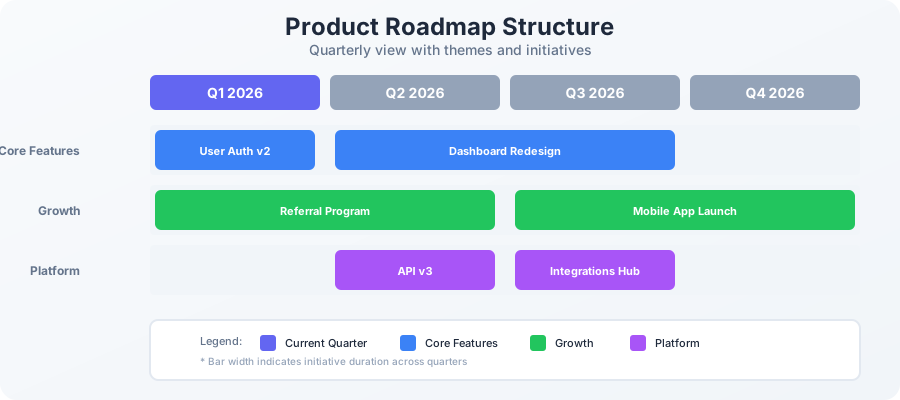
Product Roadmap Structure - Quarterly View
A visual example of a quarterly roadmap organized by themes with initiatives spanning multiple quarters.
What Makes a Great Product Roadmap?
A product roadmap is a strategic document that outlines the vision, direction, priorities, and progress of a product over time. It communicates what you plan to build, why it matters, and roughly when—aligning your team, stakeholders, and customers around a shared vision. The best roadmaps tell a story about where your product is headed and why.
Common roadmap mistakes include: committing to specific dates too early, listing features without explaining the value, failing to update as priorities change, and using one roadmap for all audiences. This guide will help you avoid these pitfalls.
Whether you're communicating with executives, engineering, sales, or customers, you'll learn how to choose the right format, create compelling roadmaps, and adapt your communication to different audiences.
Roadmap vs. Backlog: Key Differences
Understanding the difference between a roadmap and a backlog is essential for using each tool effectively.
Product Roadmap
- -Purpose: Strategic communication
- -Audience: Stakeholders, leadership, customers
- -Timeframe: Quarters or months
- -Detail level: High-level themes and goals
- -Question answered: What and why?
Product Backlog
- -Purpose: Operational execution
- -Audience: Development team, PM
- -Timeframe: Sprints or weeks
- -Detail level: Specific tasks and user stories
- -Question answered: What and how?
Roadmap Formats
Choose the right roadmap format based on your audience and communication needs:
Timeline Roadmap
Shows features or initiatives plotted against calendar time (quarters, months)
Best for: Executive presentations, annual planning, external communication
Pros
- +Clear time expectations
- +Easy to understand
- +Good for coordinating with other teams
Cons
- -Can create date commitments
- -Less flexible
- -May emphasize dates over outcomes
Now/Next/Later
Organizes work by relative priority without specific dates
Best for: Agile teams, internal communication, uncertain timelines
Pros
- +Flexible
- +Focuses on priorities
- +Reduces date pressure
Cons
- -Less specific timing
- -May frustrate stakeholders wanting dates
- -Requires explanation
Theme-Based Roadmap
Groups work by strategic themes or objectives rather than features
Best for: Outcome-focused teams, OKR alignment, strategic communication
Pros
- +Focuses on outcomes
- +Flexible on solutions
- +Aligns with strategy
Cons
- -Less specific
- -Harder to track progress
- -May lack detail for some audiences
Kanban Roadmap
Shows work flowing through stages: discovery, design, development, launch
Best for: Teams practicing continuous delivery, portfolio management
Pros
- +Shows work in progress
- +Visual flow
- +Good for continuous planning
Cons
- -No time dimension
- -Can be complex
- -May lack strategic context
Real-World Roadmap Example
See how a real product team might structure their roadmap. This example shows TaskFlow (B2B Project Management SaaS) — Series A startup with 50 customers, looking to move upmarket to enterprise.
TaskFlow (B2B Project Management SaaS) — Q1 2026 Roadmap
Strategic focus: Enterprise expansion
Enterprise SSO Integration
Remove the #1 blocker for enterprise deals by enabling SAML/OIDC authentication
Key Results:
- -Support Okta, Azure AD, and Google Workspace
- -Pass SOC 2 security review
- -Close 3 enterprise deals blocked by SSO requirement
Performance Optimization
Improve page load times to support larger customer workspaces (10K+ tasks)
Key Results:
- -Reduce p95 page load from 4s to <1.5s
- -Support workspaces with 50K+ tasks
- -Reduce infrastructure costs by 20%
Advanced Permissions & Audit Logs
Give enterprise admins granular control over who can do what, with full audit trail
Why now: Required for SOC 2 Type II and enterprise security reviews
Open Questions:
- ?Custom roles vs. predefined roles?
- ?How long to retain audit logs?
Workflow Automation Builder
Let users automate repetitive tasks without engineering support
Why now: Top requested feature from power users; competitors have this
Open Questions:
- ?Build vs. integrate with Zapier?
- ?What triggers/actions to support first?
Resource Management & Capacity Planning
Problem: Managers cannot see team workload across projects, leading to burnout and missed deadlines
Hypothesis: Adding resource views will increase retention in teams >20 people by 15%
Validation needed: Interview 10 customers with 50+ users about current workarounds
AI-Powered Task Suggestions
Problem: Users spend too much time on task organization and prioritization
Hypothesis: AI can reduce time spent on task management by 30%
Validation needed: Build prototype and test with 5 power users
Now/Next/Later Template (Copy-Ready)
A complete, copy-ready template with all the sections you need. Click the button to copy and paste into your doc or project management tool.
Now/Next/Later Roadmap Template
Complete template with vision, themes, and confidence levels
# Product Roadmap: [Product Name]

| Field | Value |
|-------|-------|
| **Last Updated** | [Date] |
| **Owner** | [PM Name] |
| **Review Cadence** | [Monthly/Quarterly] |

## Vision

[One sentence describing where the product is headed in 12-18 months]

## Strategic Themes for [Year]

1. **[Theme 1]:** e.g., "Improve user activation"
2. **[Theme 2]:** e.g., "Expand enterprise capabilities"
3. **[Theme 3]:** e.g., "Reduce operational costs"

---

## 🟢 NOW (Current Quarter - High Confidence)

> These initiatives are actively in progress or starting within 2-4 weeks.
> **Confidence:** 80-90% | Detailed planning complete

### Initiative: [Initiative Name]

- **Objective:** [What outcome are we driving?]
- **Key Results:**
  - [Measurable outcome 1]
  - [Measurable outcome 2]
- **Status:** [Discovery | Design | Development | Beta | Launched]
- **Owner:** [Name]
- **Target:** [Month]
- **Dependencies:** [List any blockers or dependencies]

### Initiative: [Initiative Name 2]

- **Objective:** [What outcome are we driving?]
- **Key Results:**
  - [Measurable outcome 1]
  - [Measurable outcome 2]
- **Status:** [Status]
- **Owner:** [Name]
- **Target:** [Month]

---

## 🔵 NEXT (Next Quarter - Medium Confidence)

> Planned for next quarter, pending completion of "Now" items.
> **Confidence:** 50-70% | High-level scoping complete

### Initiative: [Initiative Name]

- **Objective:** [What outcome are we driving?]
- **Why Now:** [Why is this the right time for this initiative?]
- **Open Questions:**
  - [What do we still need to figure out?]
- **Estimated Effort:** [T-shirt size: S/M/L/XL]
- **Depends On:** [What from "Now" must complete first?]

### Initiative: [Initiative Name 2]

- **Objective:** [What outcome are we driving?]
- **Why Now:** [Why is this the right time?]
- **Estimated Effort:** [T-shirt size]

---

## 🟣 LATER (Future - Low Confidence)

> On our radar but not yet committed. May change based on learnings.
> **Confidence:** 20-40% | Conceptual only

### Opportunity: [Opportunity Name]

- **Problem:** [What user/business problem does this solve?]
- **Hypothesis:** [Why do we think this matters?]
- **Validation Needed:** [What do we need to learn before committing?]

### Opportunity: [Opportunity Name 2]

- **Problem:** [What problem does this solve?]
- **Hypothesis:** [Why do we think this matters?]

---

## ⛔ NOT DOING (Explicitly Deprioritized)

> Things we've considered but decided not to pursue this year.

- **[Item 1]:** [Brief reason why not]
- **[Item 2]:** [Brief reason why not]
- **[Item 3]:** [Brief reason why not]

---

## Changelog

| Date | Change |
|------|--------|
| [Date] | [What changed and why] |
| [Date] | [What changed and why] |
Timeline Roadmap Template (Copy-Ready)
A quarterly timeline format that works well for executive presentations and cross-team coordination. Includes confidence levels that decrease as you look further out.
Timeline Roadmap Template
Quarterly format with confidence levels
# Product Roadmap [Year]

**[Product Name]** | Vision: [One-line vision statement]

| Field | Value |
|-------|-------|
| **Last Updated** | [Date] |
| **Owner** | [PM Name] |

## Annual Objectives

1. [Objective 1 with target metric]
2. [Objective 2 with target metric]
3. [Objective 3 with target metric]

---

## Q1 [Year] — Theme: [Quarterly Theme]

### ✅ COMMITTED (High confidence - will ship)

| Initiative | Description | Owner | Expected Outcome |
|------------|-------------|-------|------------------|
| [Initiative 1] | [Brief description] | [Name] | [Expected impact/metric] |
| [Initiative 2] | [Brief description] | [Name] | [Expected impact/metric] |

### 📋 PLANNED (Medium confidence - targeting this quarter)

- **[Initiative 3]:** [Brief description]
  - *Dependency:* [What it depends on]
- **[Initiative 4]:** [Brief description]

### 🎯 Key Milestones

- **[Date]:** [Milestone 1]
- **[Date]:** [Milestone 2]

---

## Q2 [Year] — Theme: [Quarterly Theme]

### 📋 PLANNED (Medium confidence)

- **[Initiative 1]:** [Brief description]
  - *Why Q2:* [Why this timing?]
- **[Initiative 2]:** [Brief description]

### 🔍 EXPLORING (Lower confidence - still validating)

- **[Initiative 3]:** [Brief description]
  - *Open Question:* [What we need to learn]

---

## Q3 [Year] — Theme: [Quarterly Theme]

### 🧭 DIRECTIONAL (Lower confidence - subject to change)

- **[Theme/Initiative 1]:** [High-level description]
  - *Hypothesis:* [Why we think this matters]
- **[Theme/Initiative 2]:** [High-level description]

---

## Q4 [Year] — Theme: [Quarterly Theme]

### 💫 ASPIRATIONAL (Lowest confidence - vision only)

- **[Theme 1]:** [High-level direction]
- **[Theme 2]:** [High-level direction]

---

## Dependencies & Risks

| Type | Description | Mitigation |
|------|-------------|------------|
| Dependency | [Dependency 1] | [Mitigation plan] |
| Risk | [Risk 1] | [Mitigation plan] |

## Resources

- **Engineering:** [X] engineers allocated
- **Design:** [X] designers allocated
- **Key hires needed:** [List]

---

> **Note:** Confidence decreases as we look further out. Q1 items are commitments; Q4 items are directional and will be refined as we learn more.
Communicating to Different Stakeholders
Different audiences need different roadmap presentations. Tailor your communication to each group's needs and concerns.
Executives
What They Need
Strategic alignment, business impact, high-level timeline
Recommended Format
Theme-based or timeline roadmap, quarterly view
Pro Tips
Focus on outcomes and business metrics. Show how roadmap ties to company goals. Keep it to one page.
Example
Show: "Q2: Launch enterprise tier (projected +$2M ARR)" rather than "Q2: Add SSO, audit logs, role permissions"
Engineering
What They Need
Technical context, dependencies, capacity implications
Recommended Format
Now/Next/Later or Kanban, with technical details
Pro Tips
Include technical considerations and dependencies. Involve them in estimation. Show connection to backlog.
Example
Include: "Requires API v3 migration (2 sprints) before starting" and link to technical design docs
Sales
What They Need
Features to sell, competitive positioning, timing for deals
Recommended Format
Timeline with key features, customer-facing language
Pro Tips
Highlight features that address common objections. Be clear about what is committed vs. planned.
Example
Use: "Q3: Advanced reporting (addresses #1 enterprise objection)" with confidence indicators
Customers
What They Need
Product direction, upcoming improvements, feedback opportunities
Recommended Format
High-level themes, no specific dates
Pro Tips
Focus on problems being solved, not features. Avoid date commitments. Collect feedback.
Example
Say: "Coming soon: Better ways to collaborate with your team" not "Q2: Real-time collaboration features"
Roadmap Tools Comparison
Choose the right tool based on your team size, budget, and needs:
| Tool | Best For | Price |
|---|---|---|
| Productboard Feature-rich roadmapping with customer feedback integration | + Excellent feedback management + Beautiful roadmap views | $$$$ |
| Aha! Comprehensive product management with strategy-to-delivery workflow | + Full product management suite + Customizable | $$$$ |
| Notion Flexible workspace that can be customized for roadmaps | + Very flexible + Affordable | $$ |
| Linear Modern issue tracker with built-in roadmap views | + Fast and modern + Good Jira alternative | $$$ |
| Google Slides / Miro Visual tools for creating custom roadmap presentations | + Familiar tools + Fully customizable | $ |
Need to Document Feature Requirements?
Once you've defined your roadmap priorities, document individual features with a PRD (Product Requirements Document). PRDs transform roadmap items into actionable requirements for your engineering team.
Get our free PRD TemplateRoadmap Best Practices
Do This
- +Focus on outcomes over features
- +Keep it updated (at least quarterly)
- +Tailor format to your audience
- +Connect items to strategic goals
- +Leave room for flexibility
Avoid This
- -Committing to specific dates too early
- -Treating roadmap as a contract
- -Using same roadmap for all audiences
- -Listing features without explaining why
- -Letting it become stale
Frequently Asked Questions
What is a product roadmap?
A product roadmap is a strategic document that outlines the vision, direction, and progress of a product over time. It communicates what you plan to build, why, and roughly when. Unlike a project plan with fixed dates, a roadmap is a living document that shows strategic intent and priorities. It helps align teams and stakeholders around product direction without committing to specific deadlines.
What is the difference between a roadmap and a backlog?
A roadmap is a strategic communication tool that shows themes, goals, and rough timing for upcoming work. A backlog is an operational tool containing detailed, prioritized items ready for development. The roadmap answers "what are we building and why?" while the backlog answers "what specific tasks need to be done?" Roadmap items are typically large initiatives; backlog items are specific user stories or tasks.
How far ahead should a roadmap plan?
Most product roadmaps cover 3-12 months, with more detail in the near term and less certainty further out. A common approach is to have detailed plans for the next quarter, directional themes for the following quarter, and high-level vision for 6-12 months out. Planning too far ahead with specific features creates false precision. The key is matching detail level to confidence level.
Should a roadmap include dates?
It depends on your audience and organizational culture. Internal roadmaps can use rough timeframes (Q1, Q2) or relative terms (Now, Next, Later). External roadmaps should generally avoid specific dates to prevent commitments you cannot keep. If dates are required, use ranges or quarters rather than specific dates, and clearly communicate that dates are targets, not commitments.
What is a Now/Next/Later roadmap?
A Now/Next/Later roadmap organizes work by relative priority rather than calendar dates. "Now" contains current priorities (in progress or starting soon). "Next" includes items planned for the near future once current work is complete. "Later" holds future possibilities still being evaluated. This format reduces pressure to commit to specific dates while still communicating priorities.
How often should you update a roadmap?
Roadmaps should be reviewed and updated at least quarterly, though many teams do monthly reviews. Update when priorities shift significantly, new information emerges, or items are completed. Avoid updating too frequently (creates confusion) or too rarely (becomes stale). The key is maintaining the roadmap as a living document that reflects current strategic thinking.
Who should have input on the roadmap?
Product managers own the roadmap but should gather input from multiple sources: customers (needs and feedback), sales (market demands), support (pain points), engineering (technical opportunities and constraints), leadership (strategic direction), and data (usage patterns and opportunities). The PM synthesizes these inputs to create a coherent roadmap aligned with company strategy.
What is the best tool for creating roadmaps?
Popular roadmap tools include Productboard (feature-rich, customer-feedback focused), Aha! (comprehensive product management), Notion (flexible, collaborative), Jira (integrates with development workflow), and even simple tools like Google Slides or Miro for visual roadmaps. The best tool depends on your needs: audience, integration requirements, team size, and budget. Simple tools often work better than complex ones.
About the Author

Aditi Chaturvedi
·Founder, Best PM JobsAditi is the founder of Best PM Jobs, helping product managers find their dream roles at top tech companies. With experience in product management and recruiting, she creates resources to help PMs level up their careers.