
The Short Answer
An OKR template is a goal-setting framework that pairs an inspiring objective with 2–4 measurable key results to align teams and track quarterly progress.
The framework pairs each qualitative objective with 2–4 quantitative key results. Most teams set 3–5 objectives per quarter and treat a 0.7 (70%) score as success for stretch goals. This template includes company, team, and individual examples plus scoring methodology.
Key Takeaways
| Detail | At a Glance | Notes |
|---|---|---|
| What it is | Objectives & Key Results | One qualitative objective + 2–4 quantitative key results |
| Best for | Teams aligning on goals | Company, team, and individual levels |
| Recommended scope | 3–5 objectives | 2–4 key results per objective |
| Target score | 0.7 (70%) | Sweet spot for stretch OKRs |
| Cycle length | ~90 days | Weekly check-ins, monthly reviews, quarterly scoring |
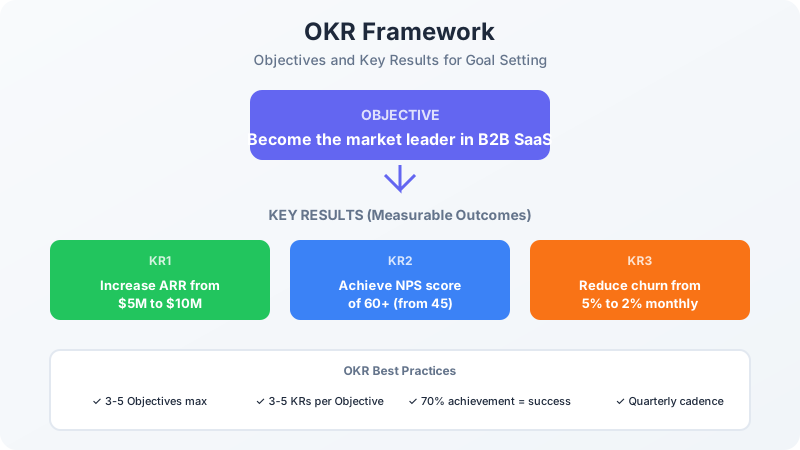
OKR Framework
OKRs (Objectives and Key Results) provide a framework for setting ambitious goals with measurable outcomes.
What are OKRs and Why Do They Matter?
OKRs (Objectives and Key Results) are a goal-setting framework that helps organizations align around ambitious goals and track measurable progress. Popularized by John Doerr at Intel and later Google, OKRs are now used by companies of all sizes to drive focus and accountability.
The framework is simple: an Objective is what you want to achieve (qualitative, inspiring), and Key Results are how you will measure progress (quantitative, specific). This combination ensures teams know both the destination and how to tell if they're getting there.
This guide provides a complete OKR template with examples at company, team, and individual levels. You'll learn the scoring methodology, common mistakes to avoid, and best practices for making OKRs work in your organization.
OKR Structure & Format
Every OKR consists of one Objective and 2-4 Key Results. Here's the structure:
Objective
A qualitative, inspiring statement describing what you want to achieve.
Characteristics of good Objectives:
- - Qualitative (not a number)
- - Inspiring and meaningful
- - Time-bound (quarterly or annual)
- - Actionable by the team
- - Aligned with company strategy
Key Results (2-4 per Objective)
Quantitative metrics that measure how you'll know you achieved the objective.
Characteristics of good Key Results:
- - Quantitative (measurable with a number)
- - Include baseline and target
- - Outcome-focused (not tasks)
- - Achievable but stretching
- - Within the team's influence
Real-World OKR Example
See how a product team might structure OKRs with full context, including initiatives and mid-quarter progress tracking. This example shows CloudSync (B2B File Sync SaaS) — Q1 2026 OKRs for the Growth Product Team (6 people) at a Series A startup.
Growth Product Team — Q1 2026 OKRs
Week 6 of 13 | Mid-quarter check-in
Make CloudSync the easiest enterprise file sync tool to adopt
Why: Win rate data shows we lose 40% of enterprise deals due to "complex setup." Simplifying adoption is our biggest growth lever.
Reduce enterprise trial-to-paid conversion time from 21 days to 10 days
Baseline
21 days average
Current
16 days (Week 6)
Target
10 days average
Initiatives driving this KR:
Increase self-serve enterprise signups from 12% to 35% of total enterprise leads
Baseline
12% self-serve
Current
22% (Week 6)
Target
35% self-serve
Initiatives driving this KR:
Achieve 85%+ "Easy to set up" rating in post-onboarding survey (n>200)
Baseline
62% (n=150)
Current
71% (n=180, Week 6)
Target
85%+ (n>200)
Initiatives driving this KR:
OKR Examples by Organizational Level
See how OKRs cascade from company to team to individual, with full context on why each objective matters and detailed key results with baselines and targets:
Series B SaaS company ($15M ARR) focused on growth and market expansion
Establish market leadership in the SMB project management space
Why this objective: Winning SMB market share is critical for Series C positioning and creates a foundation for enterprise expansion
Increase ARR from $15M to $22M (47% growth)
Requires 500 new customers at $14K ACV
Achieve #1 ranking on G2 for "Project Management for Small Teams"
Focus on review volume and recency
Reduce customer acquisition cost from $3,200 to $2,400
Through improved organic and PLG channels
Increase Net Revenue Retention from 105% to 115%
Via expansion revenue and reduced churn
Product team of 8 (2 PMs, 4 engineers, 2 designers) supporting the core platform
Transform our onboarding into a competitive advantage that drives activation
Why this objective: User research shows 60% of churned users never completed onboarding—fixing this is the highest-leverage opportunity for growth
Increase Day-7 activation rate from 23% to 45%
Activation = completed first project with team
Reduce median time-to-first-value from 4.2 days to 1.5 days
First value = invited team member + created task
Achieve 4.5+ average rating on in-app onboarding feedback (n>500)
Deploy feedback modal at onboarding completion
Mid-level PM responsible for mobile experience, 2 years at company
Launch a mobile app that delights users and drives engagement
Why this objective: 40% of users access via mobile web; native app will improve experience and enable push notifications for engagement
Ship iOS app to App Store with 4.5+ star rating (n>100 reviews)
Focus on core use cases: view tasks, notifications, quick add
Achieve 15% of DAU using mobile app within 60 days of launch
Requires email campaign + in-app promotion
Mobile users show 20% higher 7-day retention vs mobile web
Push notifications expected to drive retention lift
Conduct 25 user interviews and synthesize into v1.1 roadmap
Mix of beta users and churned mobile web users
OKR Template (Copy-Ready)
A comprehensive OKR template with alignment section, weekly check-in format, and end-of-quarter scoring. Click the copy button to use in your docs or project management tool.
OKR Planning Template
Includes alignment, tracking, scoring, and retrospective sections
# OKR Planning Document

| Field | Value |
|-------|-------|
| **Quarter** | Q[X] [Year] |
| **Team/Individual** | [Name] |
| **Last Updated** | [Date] |
| **Review Cadence** | Weekly check-ins, monthly reviews, quarterly scoring |

---

## Alignment

- **Company Objective this supports:** [Which company OKR does this ladder up to?]
- **How this contributes:** [Brief explanation of how achieving this helps the company goal]

---

## Objective 1: [Inspiring, qualitative goal statement]

| Field | Value |
|-------|-------|
| **Type** | [Committed / Aspirational] |
| **Why this matters** | [2-3 sentences on why this objective is important right now] |

### Key Result 1.1

| Field | Value |
|-------|-------|
| **Metric** | [What you're measuring] |
| **Baseline** | [Current state with date measured] |
| **Target** | [Goal state] |
| **Progress** | [Current progress - update weekly] |
| **Confidence** | [High/Medium/Low] |
| **Notes** | [Context, dependencies, risks] |

### Key Result 1.2

| Field | Value |
|-------|-------|
| **Metric** | [What you're measuring] |
| **Baseline** | [Current state] |
| **Target** | [Goal state] |
| **Progress** | [Current progress] |
| **Confidence** | [High/Medium/Low] |
| **Notes** | [Context, dependencies, risks] |

### Key Result 1.3

| Field | Value |
|-------|-------|
| **Metric** | [What you're measuring] |
| **Baseline** | [Current state] |
| **Target** | [Goal state] |
| **Progress** | [Current progress] |
| **Confidence** | [High/Medium/Low] |
| **Notes** | [Context, dependencies, risks] |

### Initiatives

> What we'll do to achieve the Key Results:

- **[Initiative 1]:** [Brief description]
- **[Initiative 2]:** [Brief description]
- **[Initiative 3]:** [Brief description]

---

## Objective 2: [Inspiring, qualitative goal statement]

| Field | Value |
|-------|-------|
| **Type** | [Committed / Aspirational] |
| **Why this matters** | [2-3 sentences on why this objective is important] |

### Key Result 2.1

| Field | Value |
|-------|-------|
| **Metric** | [What you're measuring] |
| **Baseline** | [Current state] |
| **Target** | [Goal state] |
| **Progress** | [Current progress] |
| **Confidence** | [High/Medium/Low] |
| **Notes** | [Context] |

### Key Result 2.2

| Field | Value |
|-------|-------|
| **Metric** | [What you're measuring] |
| **Baseline** | [Current state] |
| **Target** | [Goal state] |
| **Progress** | [Current progress] |
| **Confidence** | [High/Medium/Low] |
| **Notes** | [Context] |

### Initiatives

- **[Initiative 1]:** [Brief description]
- **[Initiative 2]:** [Brief description]

---

## Dependencies & Risks

| Item | Description | Mitigation Plan |
|------|-------------|-----------------|
| [Dependency/Risk 1] | [Description] | [Mitigation plan] |
| [Dependency/Risk 2] | [Description] | [Mitigation plan] |

## Resources Needed

| Resource | Status |
|----------|--------|
| [Resource 1] | [What you need and current status] |
| [Resource 2] | [What you need and current status] |

---

## Weekly Check-in Template

### Week of [Date]

**O1 Progress:** [Brief update]
- KR1.1: **[X%]** - [One line status]
- KR1.2: **[X%]** - [One line status]
- KR1.3: **[X%]** - [One line status]

**O2 Progress:** [Brief update]

**Blockers:** [Any blockers to flag]

**Help needed:** [Any asks for leadership/other teams]

---

## End-of-Quarter Scoring

### Objective 1: [Final score 0.0-1.0]

| Key Result | Score | Explanation |
|------------|-------|-------------|
| KR1.1 | [Score] | [Brief explanation] |
| KR1.2 | [Score] | [Brief explanation] |
| KR1.3 | [Score] | [Brief explanation] |

### Objective 2: [Final score 0.0-1.0]

| Key Result | Score | Explanation |
|------------|-------|-------------|
| KR2.1 | [Score] | [Brief explanation] |
| KR2.2 | [Score] | [Brief explanation] |

---

## Retrospective

### What worked well
- [Learning 1]
- [Learning 2]

### What to improve
- [Improvement 1]
- [Improvement 2]

### Carry forward to next quarter
- [Item 1]
- [Item 2]
OKR Scoring Methodology
Score each Key Result at the end of the cycle using a 0.0 to 1.0 scale. For stretch OKRs, 0.7 (70%) is considered a successful outcome.
| Score | Meaning | Interpretation |
|---|---|---|
| 1.0 | Fully achieved | Met or exceeded all expectations |
| 0.7 | Strong progress | Stretch goal—this is the target for ambitious OKRs |
| 0.5 | Partial progress | Made significant progress but fell short |
| 0.3 | Limited progress | Some progress but missed the mark substantially |
| 0.0 | No progress | Failed to make meaningful progress |
Calculating Objective Score
Average the scores of all Key Results to get the Objective score. For example, if your three Key Results scored 0.8, 0.6, and 0.7, your Objective score would be 0.7 (70%).
Common OKR Mistakes to Avoid
Learn from these common pitfalls to make your OKRs more effective:
Too many OKRs
Problem
Having 10+ objectives dilutes focus and makes everything equally (un)important
Solution
Limit to 3-5 objectives per team with 2-4 key results each
Key Results that are tasks, not outcomes
Problem
"Launch feature X" is a task; it does not measure impact or success
Solution
Focus on measurable outcomes: "Increase conversion by 20% through feature X"
Setting easy, sandbagged OKRs
Problem
When OKRs affect bonuses, people set conservative goals they know they can hit
Solution
Use stretch goals (70% = success) and decouple OKRs from compensation
Objectives that are not inspiring
Problem
"Maintain current metrics" does not motivate anyone
Solution
Write objectives that describe a better future state worth striving for
Key Results without baselines
Problem
"Improve customer satisfaction" cannot be measured without a starting point
Solution
Always include current state and target: "Improve NPS from 32 to 45"
Set-and-forget OKRs
Problem
Writing OKRs at the start of quarter and never reviewing them
Solution
Check weekly, review monthly, score and retrospect quarterly
Top-down dictated OKRs
Problem
Leadership assigns OKRs without team input, reducing ownership
Solution
Company sets direction; teams propose how they will contribute
No connection between levels
Problem
Individual OKRs that do not roll up to team or company goals
Solution
Ensure clear line of sight from individual to company objectives
OKR Review Cadence
Successful OKR programs require regular check-ins, not just quarterly setting and scoring:
Weekly Check-ins
Brief updates on Key Result progress. What moved? What's blocked? Takes 5-10 minutes.
Monthly Reviews
Are we on track? Do we need to adjust tactics? Score current progress and identify risks.
Quarterly Scoring
Final scores, retrospective, and setting next quarter's OKRs. What did we learn?
OKR Best Practices
Do This
- +Start with company OKRs, then cascade down
- +Focus on outcomes, not tasks or outputs
- +Include baselines in every Key Result
- +Make OKRs public for transparency
- +Separate stretch OKRs from commitments
Avoid This
- -Tying OKRs directly to compensation
- -Setting more than 5 objectives per team
- -Using tasks as Key Results
- -Changing OKRs mid-quarter without cause
- -Setting OKRs in isolation from team input
Frequently Asked Questions
What are OKRs?
OKRs (Objectives and Key Results) are a goal-setting framework used by organizations to define and track objectives and their outcomes. An Objective is a qualitative, inspiring goal that describes what you want to achieve. Key Results are quantitative metrics that measure progress toward the objective. OKRs were popularized by Intel and Google, and are now used by thousands of companies worldwide.
How many OKRs should a team have?
Most teams should have 3-5 objectives per cycle, with 2-4 key results per objective. Having too many OKRs dilutes focus and makes it impossible to prioritize. If everything is a priority, nothing is. Start with fewer OKRs and add more only if you have capacity. Quality over quantity—focused teams outperform scattered ones.
What is the difference between OKRs and KPIs?
KPIs (Key Performance Indicators) measure ongoing business health and are typically "business as usual" metrics that you monitor continuously. OKRs are time-bound goals for improvement or change. KPIs answer "how are we doing?" while OKRs answer "where are we going?" A KPI might be "customer satisfaction score" while an OKR might be "Improve customer satisfaction from 7.5 to 8.5 this quarter."
Should OKRs be tied to compensation?
Most OKR experts recommend against tying OKRs directly to compensation. When OKRs affect pay, people set conservative, easily achievable goals rather than ambitious stretch goals. The purpose of OKRs is to drive alignment and focus on what matters most, not to evaluate performance. Use OKRs for direction, and consider other factors for compensation decisions.
What is a good OKR score?
For stretch OKRs (the recommended type), achieving 60-70% is typically considered successful. Consistently scoring 100% means you are setting OKRs that are not ambitious enough. Consistently scoring below 40% might mean OKRs are too aggressive or there are execution issues. The Google model suggests 0.7 (70%) as the "sweet spot" for well-calibrated OKRs.
How often should OKRs be reviewed?
OKRs should be checked weekly (brief progress updates), reviewed monthly (are we on track?), and formally scored at the end of each cycle (typically quarterly). Weekly check-ins help catch problems early. Monthly reviews allow for course correction. Quarterly scoring provides a retrospective on what worked and what did not.
What is the difference between committed and aspirational OKRs?
Committed OKRs are goals the team expects to fully achieve (100%) and have planned resources for. Aspirational (stretch) OKRs are ambitious goals where achieving 60-70% would be considered success. Most organizations use a mix: some committed OKRs for essential deliverables and aspirational OKRs to drive innovation and growth. Label them clearly so expectations are aligned.
How do OKRs cascade through an organization?
Company OKRs set the overall direction, typically owned by leadership. Team OKRs align with company OKRs but focus on what the team can directly influence. Individual OKRs (if used) align with team OKRs. This creates alignment without micromanagement. Teams should have autonomy in how they contribute to company goals rather than having OKRs dictated from above.
About the Author

Aditi Chaturvedi
·Founder, Best PM JobsAditi is the founder of Best PM Jobs, helping product managers find their dream roles at top tech companies. With experience in product management and recruiting, she creates resources to help PMs level up their careers.