
The Short Answer
The Kano Model categorizes product features by their effect on customer satisfaction into five categories: Basic (Must-be), Performance (One-Dimensional), Excitement (Delighters), Indifferent, and Reverse.
Created by Professor Noriaki Kano in the 1980s, the model shows that customer satisfaction isn't linear: missing a Basic feature angers customers while adding more of it does nothing, and an unexpected Delighter creates outsized satisfaction. Categories are gathered through a paired-question Kano survey.
Key Takeaways
| Detail | At a Glance | Notes |
|---|---|---|
| Categories | Basic, Performance, Excitement, Indifferent, Reverse | Must-be, One-Dimensional, Delighters, no impact, dislike |
| What it solves | Maximizing customer satisfaction | Reveals satisfaction is non-linear across feature types |
| Best for | Prioritizing features with limited resources | Deciding what to build, cut, or differentiate on |
| How to gather data | Kano survey | Paired functional + dysfunctional questions, 20–30 customers |
| Created by | Noriaki Kano | Developed in the 1980s |
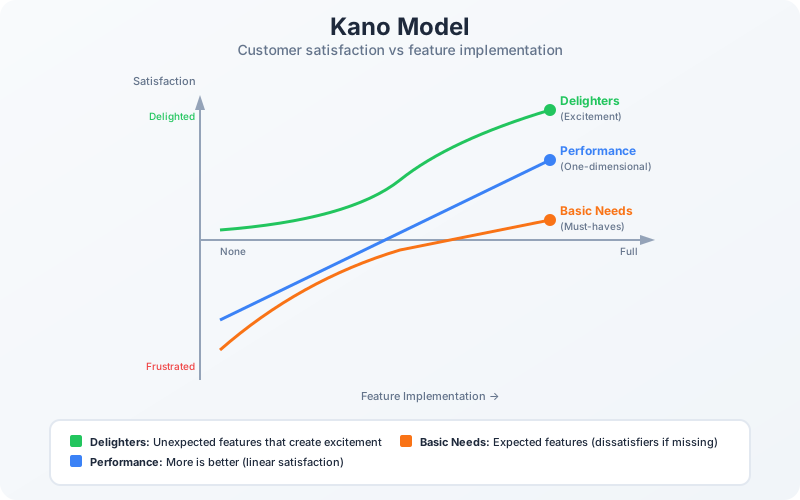
Kano Model - Customer Satisfaction vs Feature Implementation
Use the Kano Model to categorize features based on how they impact customer satisfaction when implemented versus when absent.
What is the Kano Model?
The Kano Model is a product development framework that categorizes features based on how they affect customer satisfaction. Developed by Professor Noriaki Kano in the 1980s, it reveals that not all features are equal—some are basic expectations, others drive satisfaction proportionally, and some create unexpected delight.
The key insight of the Kano Model is that customer satisfaction isn't linear. Adding more of a basic feature won't make customers happier, but missing it will make them very unhappy. Conversely, a delighter feature creates disproportionate satisfaction even though customers didn't know they wanted it.
Understanding these dynamics helps product managers prioritize features strategically—ensuring basics are covered, competing on performance features, and creating differentiation through thoughtful delighters.
The Five Kano Categories
Must-Be (Basic)(Atarimae)
Features customers expect as baseline. Their absence causes major dissatisfaction, but their presence doesn't increase satisfaction—it's just expected.
Satisfaction Curve
Absent: Very dissatisfied → Present: Neutral
Strategy
Ensure these are solid before investing in other features. Never skip basics.
Examples
One-Dimensional (Performance)(Ichi-gen-teki)
Features where satisfaction scales linearly with performance. The better they are, the more satisfied customers become.
Satisfaction Curve
Poor: Dissatisfied ↔ Excellent: Very satisfied
Strategy
Compete on these. They're often key differentiators where "more is better."
Examples
Attractive (Delighters)(Miryoku-teki)
Unexpected features that create excitement and differentiation. Customers don't expect them, so absence doesn't disappoint, but presence delights.
Satisfaction Curve
Absent: Neutral → Present: Very satisfied
Strategy
These create memorable experiences and word-of-mouth. Invest strategically.
Examples
Indifferent(Mu-kanshin)
Features customers don't care about either way. Neither presence nor absence affects satisfaction.
Satisfaction Curve
Absent: Neutral ↔ Present: Neutral
Strategy
Avoid investing here unless required for other reasons (technical debt, compliance).
Examples
Reverse(Gyaku)
Features that some customers actively dislike. Their presence decreases satisfaction for certain segments.
Satisfaction Curve
Absent: Satisfied ↔ Present: Dissatisfied
Strategy
Make these optional or segment carefully. One person's feature is another's annoyance.
Examples
How to Conduct Kano Analysis
Step 1: Define Features to Test
List the features you want to categorize. Be specific—test concrete capabilities, not vague concepts. Aim for 10-15 features maximum per survey to avoid respondent fatigue.
Step 2: Create Paired Questions
For each feature, ask two questions:
Functional Question
"If [feature] is present, how do you feel?"
- • I like it that way
- • I expect it that way
- • I am neutral
- • I can tolerate it that way
- • I dislike it that way
Dysfunctional Question
"If [feature] is absent, how do you feel?"
- • I like it that way
- • I expect it that way
- • I am neutral
- • I can tolerate it that way
- • I dislike it that way
Step 3: Survey Customers
Survey 20-30 representative customers from your target segment. More responses increase confidence but diminishing returns occur after ~50 responses per segment.
Step 4: Map to Categories
Use the Kano evaluation table to categorize each response based on the combination of functional and dysfunctional answers. Aggregate across respondents to determine the dominant category for each feature.
Interpreting Results
Kano Evaluation Table
| Dysfunctional (If absent...) | |||||
|---|---|---|---|---|---|
| Functional (If present...) | Like | Expect | Neutral | Tolerate | Dislike |
| Like | Q | A | A | A | O |
| Expect | R | I | I | I | M |
| Neutral | R | I | I | I | M |
| Tolerate | R | I | I | I | M |
| Dislike | R | R | R | R | Q |
Best Practices
Do This
- +Always cover Must-Be features first
- +Re-run analysis as markets evolve
- +Segment results by customer type
- +Combine with other prioritization methods
Avoid This
- -Skipping basics to build delighters
- -Treating categories as permanent
- -Surveying non-representative users
- -Testing too many features at once
Frequently Asked Questions
What is the Kano Model?
The Kano Model is a product development framework created by Professor Noriaki Kano in the 1980s. It categorizes product features based on how they affect customer satisfaction. The model identifies five categories: Must-Be (basic expectations), One-Dimensional (performance features), Attractive (delighters), Indifferent (no impact), and Reverse (cause dissatisfaction). It helps product teams prioritize features that maximize customer satisfaction.
What are the five categories in the Kano Model?
The five Kano categories are: (1) Must-Be/Basic: features customers expect—their absence causes dissatisfaction but presence doesn't increase satisfaction. (2) One-Dimensional/Performance: more is better—satisfaction scales with how well the feature performs. (3) Attractive/Delighters: unexpected features that create excitement—absence doesn't disappoint but presence delights. (4) Indifferent: features customers don't care about. (5) Reverse: features some customers actively dislike.
How do you conduct Kano analysis?
Kano analysis uses paired questions for each feature: a functional question ("How would you feel if this feature was present?") and a dysfunctional question ("How would you feel if this feature was absent?"). Respondents choose from: Like, Expect, Neutral, Tolerate, or Dislike. The combination of answers determines the category. Survey 20-30 representative customers and map responses to the Kano evaluation table.
When should you use the Kano Model?
Use Kano analysis when: prioritizing features for a new product, deciding which features to cut from scope, differentiating from competitors, understanding changing customer expectations, or validating assumptions about feature importance. It's particularly valuable when you have limited resources and need to maximize customer impact.
How do Kano categories change over time?
Kano categories naturally evolve. Today's Delighters become tomorrow's Performance features and eventually Must-Haves. For example, smartphone cameras were once delighters, then became performance differentiators, and are now basic expectations. This "Kano decay" means you must continuously innovate to maintain customer satisfaction and competitive advantage.
What is the difference between Kano and RICE prioritization?
Kano Model focuses on customer satisfaction and feature categorization—it tells you what type of feature something is. RICE (Reach, Impact, Confidence, Effort) is a scoring framework that helps prioritize specific features based on business impact and effort. They complement each other: use Kano to understand feature categories, then RICE to prioritize within those categories.
About the Author

Aditi Chaturvedi
·Founder, Best PM JobsAditi is the founder of Best PM Jobs, helping product managers find their dream roles at top tech companies. With experience in product management and recruiting, she creates resources to help PMs level up their careers.