
The Short Answer
The Jobs-to-be-Done framework holds that customers "hire" products to make progress in a circumstance, so you design for the underlying job rather than the product itself.
A job is the progress a customer wants to make in a circumstance, with functional, emotional, and social dimensions — for example, people don't buy a drill because they want a drill, they buy it because they want a hole in the wall. Because jobs stay stable while solutions change, JTBD is a durable lens for product strategy and innovation.
Key Takeaways
| Detail | At a Glance | Notes |
|---|---|---|
| Core idea | Customers "hire" products to get a job done | A job is progress made in a particular circumstance |
| Job statement format | When [situation], I want to [motivation], so I can [outcome] | Job stories replace feature-led user stories |
| What it solves | Uncovering real customer needs | Reveals what customers need, not just what they request |
| Best for | Customer-centric product strategy & innovation | Jobs stay stable while solutions change |
| Origin | Christensen & Ulwick | Popularized by Clayton Christensen and Tony Ulwick (ODI) |
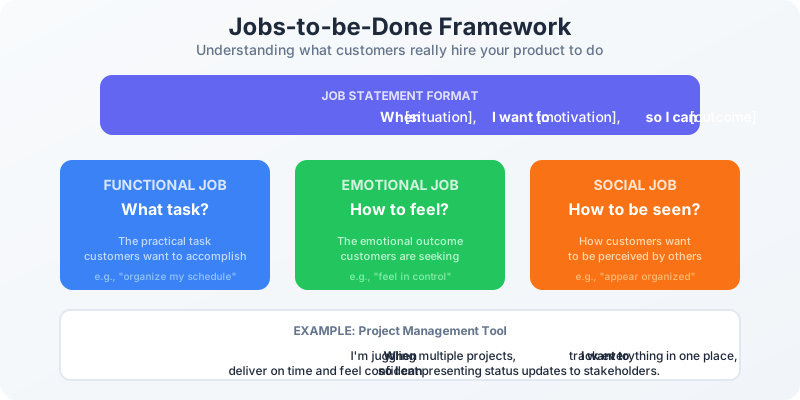
Jobs-to-be-Done Framework
JTBD helps you understand what customers really hire your product to do by focusing on functional, emotional, and social jobs.
What is Jobs-to-be-Done?
Jobs-to-be-Done (JTBD) is a theory of customer motivation that argues people "hire" products and services to get a "job" done. A job is not a task or activity—it's the progress a person is trying to make in a particular circumstance.
Popularized by Clayton Christensen (The Innovator's Dilemma) and Tony Ulwick (Outcome-Driven Innovation), JTBD has become a cornerstone of customer-centric product development. Companies like Intercom, Basecamp, and Spotify use JTBD to understand customer needs and drive innovation.
The power of JTBD lies in its stability: while products and technologies change rapidly, the underlying jobs remain consistent. People have always needed to communicate with distant family, stay entertained during commutes, and feel confident in professional settings—only the solutions change.
Core JTBD Concepts
Jobs are Stable
The job of "helping me pass time while waiting" has existed forever. Solutions evolved from newspapers to books to mobile games to TikTok—but the job remains.
Example: The job "stay informed about world events" has been solved by town criers, newspapers, radio, TV, websites, and now social media feeds. Understanding this stable job helps predict what future solutions might look like.
Customers Hire Products
People "hire" products to do a job for them and "fire" products that don't perform well. This mental model helps understand competitive dynamics—your competition isn't just similar products, but anything that gets the job done.
Example: A milkshake's competition isn't just other milkshakes—it's bananas, donuts, bagels, or even nothing at all, depending on the job (commute entertainment, morning fuel, etc.).
Context Matters
The same person might have different jobs in different circumstances. Context includes timing, location, social situation, and emotional state.
Example: When choosing lunch, the job might be "eat something healthy" (at office), "treat myself" (celebrating), or "bond with colleagues" (team outing). Same person, different contexts, different jobs.
The Three Dimensions of a Job
Every job-to-be-done has three dimensions. Understanding all three helps you build products that truly resonate with customers.
Functional
The practical task the customer is trying to accomplish
Examples:
- Get from point A to point B
- Store and access my files
- Track my business expenses
Discovery Questions:
- ?What are you trying to get done?
- ?What does success look like?
- ?What steps are involved?
Emotional
How the customer wants to feel during and after the job
Examples:
- Feel confident presenting to clients
- Feel secure about my financial future
- Feel less stressed about deadlines
Discovery Questions:
- ?How do you want to feel when this is done?
- ?What frustrates you about current solutions?
- ?What would make you feel successful?
Social
How the customer wants to be perceived by others
Examples:
- Be seen as innovative by my team
- Be recognized as a responsible parent
- Be perceived as a successful professional
Discovery Questions:
- ?How do others factor into this decision?
- ?What would others think if you succeeded?
- ?Who else is affected by this job?
Forces of Progress
When customers switch from one solution to another, four forces are at play. Understanding these forces helps you position your product and reduce friction.
Push of the Current Situation
Problems with the current situation that push customers toward change
Pull of the New Solution
Attractive qualities of the new solution that pull customers toward it
Anxiety of the New Solution
Fears and concerns about adopting something new
Habit of the Current Situation
Comfort and familiarity with the status quo
Product Implications
To win customers: Amplify the push (show problems with current solution), increase the pull (demonstrate benefits), reduce anxiety (offer trials, guarantees, onboarding), and break habits (make switching easy, import data).
How to Conduct JTBD Interviews
JTBD interviews focus on understanding the customer's journey from first thought to purchase. The "Switch Interview" technique maps this journey in detail.
First Thought
When did you first realize you needed a change?
Sample Questions:
- •What was happening in your life when you first thought about this?
- •What triggered the realization that something needed to change?
- •How long ago was that first thought?
Passive Looking
Initial exploration without commitment
Sample Questions:
- •What did you do after that first thought?
- •What information did you start gathering?
- •Who did you talk to about it?
Active Looking
Deliberate search for solutions
Sample Questions:
- •When did you start seriously looking for a solution?
- •What options did you consider?
- •What criteria were you using to evaluate?
Decision
The moment of choosing a solution
Sample Questions:
- •What made you choose this solution over others?
- •What was the final trigger for your decision?
- •What concerns did you have before deciding?
Consumption
Using the solution and evaluating outcomes
Sample Questions:
- •How did you feel after making the purchase?
- •Did the solution meet your expectations?
- •What would you do differently next time?
Writing Effective Job Statements
The Job Story Format
When [situation], I want to [motivation], so I can [expected outcome].
Unlike user stories ("As a [user], I want [feature]"), job stories focus on context and motivation, not personas and features.
Example 1: Music Streaming
When I'm working out at the gym, I want to listen to high-energy music without interruption, so I can maintain my motivation and finish my workout.
Example 2: Project Management
When I'm preparing for a team meeting, I want to quickly see the status of all active projects, so I can address blockers and keep everything on track.
Example 3: E-commerce
When I'm buying a gift for someone with specific tastes, I want to find something unique and personalized, so I can show them I put thought into the gift.
Best Practices
Do This
- +Focus on the progress customers want to make
- +Interview recent customers (memory is fresh)
- +Ask "why" multiple times to find root motivations
- +Consider all three dimensions (functional, emotional, social)
- +Document the context/circumstance, not just the need
Avoid This
- -Don't confuse jobs with solutions or features
- -Don't ask hypothetical questions about future behavior
- -Don't ignore non-consumption (when people do nothing)
- -Don't assume the job is the same across all contexts
- -Don't skip the emotional and social dimensions
Frequently Asked Questions
What is the Jobs-to-be-Done framework?
Jobs-to-be-Done (JTBD) is a framework for understanding customer needs by focusing on the underlying "job" customers are trying to accomplish rather than the product itself. A "job" is the progress a customer is trying to make in a particular circumstance. For example, people don't buy a drill because they want a drill—they buy it because they want a hole in the wall. JTBD helps product teams identify opportunities by understanding these underlying motivations.
What is the difference between JTBD and user personas?
User personas describe who your customers are (demographics, behaviors, attitudes), while JTBD describes what customers are trying to accomplish regardless of who they are. A CEO and a freelancer might have the same job-to-be-done (e.g., "stay organized with my tasks") but look completely different as personas. JTBD is more actionable for product decisions because it focuses on the outcome, not the user characteristics.
How do you conduct a JTBD interview?
JTBD interviews focus on understanding the customer's journey from first thought to purchase/usage. Key questions include: "When did you first realize you needed something?" "What were you doing when that happened?" "What solutions did you try before this?" "What made you choose this solution?" The goal is to uncover the functional, emotional, and social dimensions of the job being done.
What are the three dimensions of a job-to-be-done?
Every job has three dimensions: Functional (the practical task to accomplish), Emotional (how the customer wants to feel), and Social (how the customer wants to be perceived). For example, buying a suit: Functional = "look professional for meetings," Emotional = "feel confident," Social = "be seen as successful." Great products address all three dimensions.
How do you write a JTBD statement?
A well-formed JTBD statement follows the format: "When [situation], I want to [motivation/forces], so I can [expected outcome]." For example: "When I'm commuting to work, I want to catch up on industry news, so I can start my day informed and prepared for meetings." This format captures context, motivation, and desired outcome.
What is Outcome-Driven Innovation (ODI)?
Outcome-Driven Innovation, developed by Tony Ulwick, is a methodology built on JTBD that identifies underserved customer needs. It measures job importance and satisfaction to find opportunities. The formula is: Opportunity = Importance + (Importance - Satisfaction). High importance + low satisfaction = biggest opportunities for innovation.
How is JTBD different from feature requests?
Feature requests tell you what customers think they want; JTBD reveals what they actually need. Customers often request features based on existing solutions ("I want a faster horse"), while JTBD uncovers the underlying job ("I need to get somewhere quickly"). Understanding the job enables you to create innovative solutions customers couldn't have imagined.
Can JTBD be used with Agile development?
Yes, JTBD integrates well with Agile. Use job stories instead of user stories: "When [situation], I want to [motivation], so I can [outcome]." This keeps the team focused on customer outcomes rather than features. JTBD research informs the product backlog, and job-based metrics can track sprint success.
About the Author

Aditi Chaturvedi
·Founder, Best PM JobsAditi is the founder of Best PM Jobs, helping product managers find their dream roles at top tech companies. With experience in product management and recruiting, she creates resources to help PMs level up their careers.