
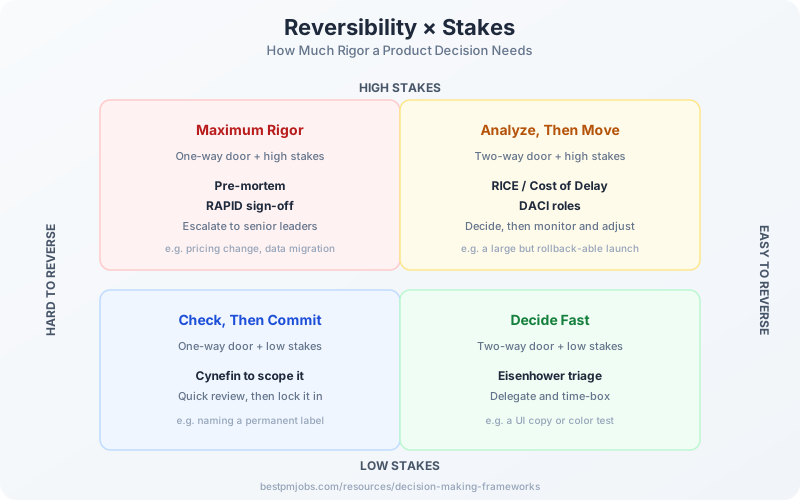
Reversibility × Stakes: How Much Rigor a Decision Needs
High stakes and low reversibility demand analysis and a pre-mortem; low stakes and high reversibility should be fast and delegated.
Product managers make dozens of decisions a week, from which feature to fund to who signs off on a launch. The frameworks below are not interchangeable: each answers a different question, so the skill is matching the framework to the decision. The quadrant above sets the first filter by reversibility and stakes, and the matrix later in this guide maps specific decision types to specific frameworks.
Looking for PM jobs? Browse opportunities on bestpmjobs.com →
The Frameworks
RICE
What it is
A scoring model that ranks options by Reach times Impact times Confidence, divided by Effort. It produces a single comparable number so a backlog can be ordered by expected value per unit of work.
When to use it
Use to prioritize a backlog of features or experiments where you can estimate reach, impact, confidence, and effort.
Steps
- Estimate Reach: how many people the option affects in a period.
- Estimate Impact and Confidence in your estimates.
- Estimate Effort in person-time.
- Compute (Reach x Impact x Confidence) / Effort and sort descending.
Example
Two features score 80 and 45; the team funds the 80-score feature first because it returns more value per unit of effort.
DACI
What it is
A role-assignment model for group decisions that names a Driver, an Approver, Contributors, and Informed parties. It ensures exactly one person owns the decision and one person can approve it.
When to use it
Use for any cross-functional decision where it is unclear who actually decides.
Steps
- Name one Driver who runs the decision process.
- Name one Approver who has final say.
- List Contributors who provide input.
- List who must be Informed of the outcome.
Example
For a pricing change, the PM is Driver, the VP is Approver, finance and sales are Contributors, and support is Informed.
RAPID
What it is
A role model that separates who Recommends, who Agrees, who Performs, who gives Input, and who Decides. Its explicit Agree role suits decisions that need formal sign-off.
When to use it
Use for regulated or cross-organization decisions where a separate party must agree before execution.
Steps
- Assign Recommend to whoever frames the proposal.
- Assign Agree to anyone whose sign-off is required.
- Assign Input to those consulted, and Decide to the single decider.
- Assign Perform to whoever executes the decision.
Example
A data-sharing feature needs legal to Agree before the PM (Recommend) and the decider sign off and engineering Performs.
Eisenhower Matrix
What it is
A 2x2 that sorts tasks by urgency and importance into do, schedule, delegate, and delete. It separates work that feels urgent from work that actually matters.
When to use it
Use to triage a flooded task list or to decide what a team should stop doing.
Steps
- Score each item as urgent or not and important or not.
- Do the urgent-and-important items now.
- Schedule the important-but-not-urgent items.
- Delegate the urgent-but-not-important items and delete the rest.
Example
A PM delegates a noisy but low-value bug, schedules a strategy doc, and deletes a vanity report nobody reads.
Cynefin
What it is
A sense-making model that places a problem in a clear, complicated, complex, or chaotic domain, then prescribes a matching response. It prevents applying analysis to problems that require experiments.
When to use it
Use when you are unsure whether a problem can be solved by best practice, expertise, experimentation, or rapid action.
Steps
- Decide whether cause and effect are obvious (clear) or need experts (complicated).
- If the answer only emerges through trial, treat it as complex.
- If everything is on fire, treat it as chaotic and act to stabilize first.
- Apply the matching response: best practice, analysis, experiments, or rapid action.
Example
A novel retention problem is treated as complex, so the team runs small experiments instead of commissioning a large analysis.
Cost of Delay
What it is
An economic model that quantifies the value lost by not shipping now. Dividing it by duration gives a CD3 score that ranks work by the financial urgency of waiting.
When to use it
Use when several initiatives compete for the same capacity and you want to sequence by economic impact.
Steps
- Estimate the value the option produces per unit of time.
- Estimate how urgent that value is (does it decay if delayed?).
- Combine the two into a Cost of Delay figure.
- Divide by duration for a CD3 score and sequence by it.
Example
A seasonal feature has a high Cost of Delay before the holidays, so it jumps ahead of an evergreen feature with similar effort.
Pre-mortem
What it is
A risk technique run before execution in which the team imagines the decision has failed and lists the reasons, then strengthens the plan against them. It surfaces risks while they can still be prevented.
When to use it
Use for high-stakes, hard-to-reverse decisions before committing.
Steps
- State the decision and assume it failed badly.
- Have each person independently write why it failed.
- Cluster the failure causes and rank by likelihood and impact.
- Add mitigations to the plan for the top risks.
Example
Before a major launch, a pre-mortem reveals an onboarding gap, so the team adds a guided setup flow before shipping.
One-way vs Two-way Door
What it is
A reversibility test that classifies a decision as a one-way door (hard to reverse, deserves analysis) or a two-way door (easily reversible, should be made fast and delegated). It matches deliberation to stakes.
When to use it
Use at the start of any decision to set how much rigor and seniority it needs.
Steps
- Ask how hard it would be to reverse the decision.
- If reversing is cheap and fast, treat it as a two-way door.
- If reversing is costly or impossible, treat it as a one-way door.
- Delegate and speed up two-way doors; analyze and escalate one-way doors.
Example
A button-color test is a two-way door decided in minutes; a database migration is a one-way door reviewed by senior engineers.
Decisions Are the Core PM Skill
Companies hire product managers who can make and defend hard calls. Browse open roles.
Find PM Jobs3,591+ active PM roles · $150K+ average salary
Which Framework for Which Decision
| Decision type | Framework | Why it fits |
|---|---|---|
| Ordering a backlog by value | RICE | Produces one comparable score per item. |
| Sequencing by economic urgency | Cost of Delay (CD3) | Ranks by the financial cost of waiting. |
| Unclear who decides | DACI | Assigns a single Driver and Approver. |
| Decision needs formal sign-off | RAPID | Adds an explicit Agree role. |
| Too many tasks, mixed urgency | Eisenhower Matrix | Separates urgent from important. |
| Unsure how complex the problem is | Cynefin | Matches approach to the problem domain. |
| High-stakes launch ahead | Pre-mortem | Surfaces risks before they happen. |
| Deciding how much rigor to apply | One-way vs Two-way Door | Matches deliberation to reversibility. |
Combine, do not collide
How to Make a Product Decision
Classify reversibility
Apply the one-way versus two-way door test to decide how much rigor and seniority the decision needs.
Assign decision roles
Use DACI or RAPID so one person owns the decision and the right people give input.
Frame the options
List the real alternatives, including the option to do nothing, with their expected outcomes.
Apply a scoring method
Use RICE or Cost of Delay to compare options on value and effort where the data supports it.
Stress-test high-stakes calls
Run a pre-mortem on one-way door decisions to surface failure modes before committing.
Decide and record
Make the call, write down the rationale, and set a date to review the outcome.
Many product decisions also require buy-in from people you do not manage. The influencing without authority guide covers how to get a decision adopted once it is made, and the product strategy frameworks guide covers the larger directional choices these decisions serve.
Use-Case Cheat Sheet
| Scenario | Recommended framework | Why |
|---|---|---|
| Cluttered backlog, no clear order | RICE | Score each item and sort by value per effort. |
| A meeting keeps re-deciding the same thing | DACI | Name one Driver and one Approver. |
| Legal must approve before launch | RAPID | The explicit Agree role enforces sign-off. |
| Everything feels urgent | Eisenhower Matrix | Triage by urgency and importance. |
| Brand-new problem with no playbook | Cynefin | Treat it as complex and experiment. |
| Two features, same effort, one is seasonal | Cost of Delay | The seasonal one loses value if delayed. |
| Big irreversible launch next month | Pre-mortem | Find failure modes before they occur. |
| Team is over-analyzing a small change | Two-way Door test | Reversible decisions should be fast. |
| A pricing change you cannot easily undo | One-way Door + Pre-mortem | Low reversibility plus high stakes needs rigor. |
Frequently Asked Questions
What is a decision-making framework?
A decision-making framework is a structured method for making consistent, defensible choices under uncertainty. It defines who decides, what criteria matter, and how options are compared, so the same situation produces a similar quality of decision regardless of who is in the room. For product managers, frameworks reduce bias, speed up routine calls, and create a record of why a decision was made.
Which decision-making framework should a product manager use?
There is no single best framework; the right one depends on the decision. Use RICE to prioritize a backlog, DACI or RAPID to assign roles in a group decision, the Eisenhower Matrix to triage by urgency and importance, Cynefin to match your approach to how complex the problem is, and the one-way versus two-way door test to decide how much deliberation a decision deserves. Most product managers keep three or four frameworks and pick by decision type.
What is the difference between DACI and RAPID?
DACI and RAPID both assign roles in a group decision, but they label them differently. DACI names a Driver, Approver, Contributors, and Informed parties. RAPID names who Recommends, who Agrees, who Performs, who gives Input, and who Decides. DACI is lighter and works well for most product decisions; RAPID adds an explicit "Agree" role that suits regulated or cross-organization decisions where sign-off is required. Both prevent the common failure where nobody owns the decision.
What is a one-way door versus a two-way door decision?
A one-way door decision is hard or impossible to reverse, such as a public pricing change or a data-model migration, so it deserves careful analysis and senior review. A two-way door decision is easily reversible, such as a UI experiment or a copy change, so it should be made quickly and delegated. The test, popularized by Amazon, prevents teams from over-analyzing reversible decisions and under-analyzing irreversible ones.
How does the Cynefin framework help product decisions?
Cynefin sorts a problem into one of several domains: clear, complicated, complex, or chaotic. In a clear domain you apply a known best practice; in a complicated domain you bring in expertise and analyze; in a complex domain you run small experiments and let the answer emerge; in a chaotic domain you act first to establish stability. Matching your decision approach to the domain prevents applying analysis to problems that can only be learned through experiments.
What is Cost of Delay and when should I use it?
Cost of Delay quantifies the economic loss of not shipping something now, combining the value of the work with how urgent it is. Dividing Cost of Delay by the effort required gives a CD3 score (Cost of Delay Divided by Duration) that ranks work by economic urgency. Use it when several initiatives compete for the same capacity and you want to sequence them by the financial impact of waiting rather than by gut feel.
What is a pre-mortem and how is it different from a retrospective?
A pre-mortem is run before a decision is executed: the team imagines the decision has failed and works backward to list the reasons, then strengthens the plan against them. A retrospective is run after work is completed to learn from what actually happened. The pre-mortem surfaces risks while they can still be prevented, which makes it a decision-quality tool rather than a learning ritual.
How do you avoid analysis paralysis when making product decisions?
Classify the decision first. If it is a two-way door, set a short time box and decide quickly because the cost of being wrong is low. Reserve deep analysis for one-way door decisions. Pair this with a clear decision owner using DACI or RAPID so the call actually gets made, and use a pre-mortem only for high-stakes, hard-to-reverse choices. The goal is to spend deliberation where reversibility is low and stakes are high.
About the Author

Aditi Chaturvedi
·Founder, Best PM JobsAditi is the founder of Best PM Jobs, helping product managers find their dream roles at top tech companies. With experience in product management and recruiting, she creates resources to help PMs level up their careers.